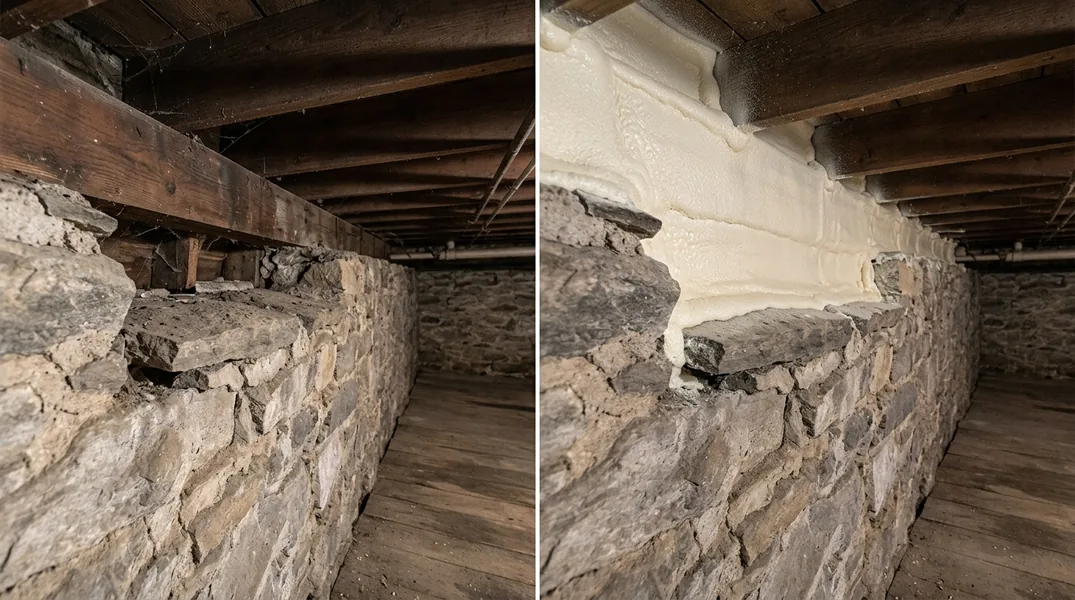
Understanding Rim Joist Air Leaks in Pine Hills Homes
If you own a home in Albany with a stone foundation, particularly in the Pine Hills neighborhood, you've likely noticed that your heating bills spike during winter months despite your best efforts to stay warm. One of the primary culprits is often overlooked by homeowners: the rim joist. This structural component sits directly on top of your foundation wall and connects the foundation to the first floor band board. In older homes with stone foundations, this junction is notoriously difficult to seal properly, creating a direct pathway for cold air to infiltrate your living spaces.
The rim joist area is particularly problematic in stone foundation homes because the irregular surface of the stone makes it nearly impossible to achieve an airtight seal with traditional insulation methods. Unlike modern poured concrete or block foundations with flat, uniform surfaces, stone foundations have gaps, crevices, and inconsistent contact points. These tiny openings act like highways for cold air, especially when combined with wind pressure during harsh Albany winters. Homeowners often spend thousands on heating but lose a significant portion of that warmth through these uninsulated or poorly insulated rim joist areas.
Spray Foam vs Blown-In Insulation: Why Spray Foam Wins for Rim Joists
When it comes to sealing rim joists effectively, the comparison between spray foam vs blown-in insulation becomes immediately clear. Blown-in insulation, whether fiberglass or cellulose, relies on gravity and settling to fill cavities. While these materials work reasonably well in open attic spaces with consistent depth, they fail dramatically at the rim joist. The irregular surfaces, tight corners, and the need for an absolute air seal make blown-in materials fundamentally inadequate for this application. Cellulose may offer slightly better coverage than fiberglass due to its ability to conform somewhat to surfaces, but even cellulose cannot create the continuous air barrier that rim joists demand.
Attic Spray Foam Insulation expands as it cures, filling every crack, crevice, and void in the rim joist assembly. This expansion capability is the key difference when comparing spray foam vs cellulose or spray foam vs fiberglass. The foam adheres directly to stone, wood, metal, and concrete, conforming perfectly to the unique geometry of your foundation. Once cured, it creates a monolithic air barrier that stops cold air infiltration at the source. For homeowners in Pine Hills and throughout Albany, this means measurably warmer basements and first floors, along with significantly reduced heating costs.
Spray Foam vs Fiberglass: The Moisture and Performance Reality
Fiberglass has been the default insulation choice for decades, and many homeowners still assume it's the best option for all applications. However, when examining spray foam vs fiberglass specifically for rim joists, the performance gap becomes undeniable. Fiberglass batts are designed to fit between studs or joists with consistent spacing. They offer virtually no air sealing capability on their own, which means you must rely on additional vapor barriers, caulking, and careful installation to achieve any meaningful air resistance. At the rim joist, where surfaces are irregular and three-dimensional, fiberglass simply cannot maintain consistent contact with the substrate.
Another critical advantage of spray foam over fiberglass is moisture management. Stone foundations in older Albany homes are prone to moisture intrusion, particularly during spring thaw and heavy rain. Fiberglass absorbs and retains moisture, which can lead to mold growth, material degradation, and loss of insulation value. Closed Cell Spray Foam Insulation is naturally moisture-resistant and actually helps prevent water vapor from migrating into wall cavities. This makes it the superior choice for damp basement and rim joist environments where moisture is a genuine concern.
Best Insulation for Attic: Why Spray Foam Outperforms Other Options
While this article focuses on rim joists, it's worth understanding how the best insulation for attic spaces also depends on your specific circumstances. Many homeowners assume that because blown-in insulation works adequately in open attic cavities, it must be suitable everywhere. However, the best insulation for attic applications often includes spray foam for critical areas like rim joists, band boards, and the attic rim joist perimeter where air sealing is paramount. When you're addressing energy efficiency holistically, combining Open Cell Spray Foam Insulation or closed cell spray foam in strategic locations with blown-in insulation in open cavities often delivers superior results compared to using a single insulation type throughout.
The energy performance difference is measurable. Homes that have had their rim joists properly sealed with spray foam report heating cost reductions of 10 to 20 percent, with the most dramatic improvements in older homes with stone foundations. This is because rim joists represent one of the largest uncontrolled air leakage points in typical homes. By sealing this area effectively, you're not just improving insulation value; you're eliminating a major source of conditioned air loss. When combined with proper attic insulation and air sealing elsewhere, spray foam at the rim joist becomes a cornerstone of a comprehensive energy efficiency strategy.
Spray Foam vs Cellulose: Durability and Long-Term Performance
Cellulose insulation has gained popularity in recent years as a more environmentally friendly option made from recycled paper. When comparing spray foam vs cellulose, homeowners often focus on environmental impact, but durability and long-term performance are equally important considerations for rim joist applications. Cellulose settles over time, typically losing 10 to 20 percent of its initial thickness within the first few years. In a rim joist application where you need consistent coverage and air sealing, this settling means gradually increasing air leakage and reduced effectiveness over time. Spray foam does not settle or compress, maintaining its air sealing properties indefinitely.
Additionally, cellulose is hygroscopic, meaning it readily absorbs and releases moisture based on humidity levels. In the damp environment surrounding a stone foundation rim joist, this characteristic can be problematic. Cellulose can support mold growth if moisture levels rise above certain thresholds, and it provides no inherent resistance to air or water vapor movement. Spray foam, by contrast, remains stable and moisture-resistant for the life of your home. While cellulose may be appropriate for certain attic applications where moisture is not a concern, rim joists demand the superior durability and moisture resistance that only spray foam can provide.
Attic Spray Foam Insulation Cost in Albany: What to Budget
Cost is always a consideration when planning home improvements, and understanding the investment required for rim joist spray foam work is essential for informed decision-making. The pricing for spray foam insulation varies based on the linear feet of rim joist to be sealed, the thickness of application, and whether you choose closed cell or open cell foam. Stone foundation homes in Pine Hills and throughout Albany typically have rim joists ranging from 100 to 200 linear feet, depending on the home's footprint. A professional installation can range from $1,500 to $4,000 or more for a complete rim joist treatment, but this investment typically pays for itself through energy savings within 5 to 10 years.
When comparing costs, it's important to consider the total value proposition. Blown-in insulation might appear cheaper upfront, costing perhaps $500 to $1,500 for the same area, but it won't achieve the air sealing performance necessary for rim joists. You'd likely need to supplement with caulking, additional air sealing, and vapor barriers, which adds cost and complexity. Spray foam delivers superior performance, durability, and air sealing in a single application. To understand the specific pricing for your home's unique situation, contact Albany Spray Foam Insulation at (838) 217-7813 or request a free estimate today. A professional assessment will identify all areas needing attention and provide transparent pricing for your project.
Attic Spray Foam Insulation Near Me: When to Call a Professional
If you're a homeowner in Pine Hills or anywhere in Albany noticing cold drafts in your basement, first-floor rooms that never seem to warm up, or heating bills that seem unreasonably high, it's time to have your rim joist professionally evaluated. While some homeowners attempt DIY spray foam applications, rim joist work requires specialized equipment, proper safety protocols, and expertise in application thickness and coverage. Professional installation ensures that you receive the full performance benefits that spray foam offers and that the work complies with building codes and manufacturer specifications.
Albany Spray Foam Insulation has helped hundreds of local homeowners solve energy efficiency problems through expert rim joist sealing and comprehensive insulation solutions. Our team understands the unique challenges presented by older homes with stone foundations and knows exactly how to address them. Whether you need rim joist sealing alone or a complete attic insulation strategy, we're here to help. Reach out today at (838) 217-7813 or visit our website to schedule your free estimate. We'll assess your home's specific needs and recommend the most effective solution to keep your home warm and your energy bills low.
Looking for a professional spray foam insulation contractor in Albany? Albany Spray Foam Insulation responds fast for all your spray foam insulation needs.
Get a Free Quote