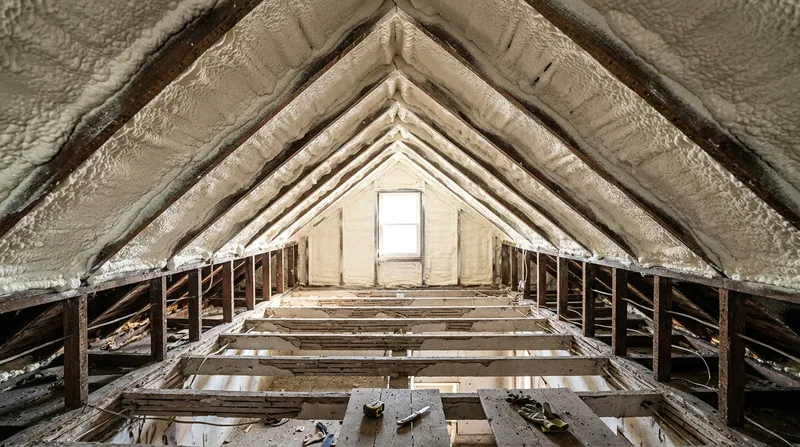




Attic spray foam insulation in Albany stops the winter moisture drive that turns rowhouse attics and sealed roof decks into condensation chambers. Albany sits in climate zone 5A, where warm indoor air pushes through old masonry walls and into cold roof cavities, pooling as water on framing and sheathing. Spray foam seals rim joists, roof decks and wall cavities in Center Square, Pine Hills, Delmar and across the Capital Region, closing the air leaks that feed ice dams on low-slope rowhouse roofs and drive heating bills through the winter. We measure thickness and R-value on site, control application ratio and cure conditions, and pull no shortcuts on ventilation or re-entry windows. The result is a sealed, insulated attic that stays dry and holds heat when it matters most.
Why Attic Insulation Fails in Albany's Cold, Humid Climate
Albany's heating-dominated winters create a relentless vapor drive: warm, moist air from living spaces rises into attics and pushes outward through old sheathing, insulation and roof decks. When that air hits the cold underside of roof shingles or the exterior wall sheathing, it condenses into liquid water. Fiberglass batts and blown cellulose trap that moisture, leading to rot in roof framing, mold growth on sheathing, and ice dams that back water into the house. The problem is worst on low-slope rowhouse roofs from Center Square to Pine Hills, where shallow cavities and poor air barriers make condensation inevitable. Spray foam stops the moisture at the source by sealing the air path before it reaches the cold boundary.
- Spray foam blocks warm, moist air from entering the attic and roof cavity in the first place.
- A sealed roof deck prevents condensation on the underside of shingles and sheathing during winter cold snaps.
- Closed cell foam also provides a vapor barrier, stopping moisture from traveling through the insulation layer itself.
- Open cell foam allows vapor to pass through but seals air gaps, reducing the driving force behind moisture movement.
- Sealed attics eliminate ice dam paths by keeping roof decks consistently above the dew point.
Each approach controls moisture differently, but both stop the condensation cycle that ruins fiberglass and drives heating costs higher every winter.
Key info: A rowhouse attic in Albany with fiberglass batts and rim joist air leaks can condense 5 to 10 gallons of water per winter season. Spray foam and air sealing eliminate that moisture and the rot it causes. See our air sealing service for the complete picture.
New York State Building Code requires attics to be vented or sealed. The 15-minute thermal barrier distinction between foam types is governed by your local building department, not by us. Always confirm what applies at your address before any work begins. The City of Albany Department of Inspections and Permits maintains the standards for residential insulation in the 12206 and 12207 zip codes; call them for clarity on your specific property.
How We Seal and Insulate Attics in Albany: A Step-by-Step Process
Attic spray foam work begins with a site inspection to map rim joists, roof deck cavities, wall plates and any existing insulation or moisture. We identify the air barrier boundary (the wall or roof plane where foam will stop air movement), measure cavity depth and width, and confirm whether the roof is vented or unvented. We then remove old insulation if it is wet, compacted or contaminated, leaving a clean substrate. Foam is sprayed in controlled passes, building thickness to meet the R-value and thermal barrier requirements your building official has specified. Mechanical ventilation runs during and after cure; re-entry is safe 24 to 48 hours after the last pass.
- We inspect the attic for moisture, air leaks, existing insulation condition and structural obstructions before quoting.
- Old insulation is removed and disposed of if it is wet, moldy or too compacted to insulate effectively.
- Rim joists and band joists are sealed with closed cell foam to stop cold air infiltration into the living space below.
- Roof decks on unvented attics are sprayed to the underside of sheathing to prevent condensation on the roof structure.
- Wall cavities in pre-1980 frame houses are sealed and insulated with injection foam to stop air leaks without demolition.
- Mechanical ventilation is maintained during cure and the space is left unoccupied for 24 to 48 hours afterward.
The result is a sealed, insulated attic that holds its temperature, stays dry and reduces heating demand all winter long.
Example: A Pine Hills rowhouse with a shallow roof cavity, old fiberglass and rim joist air leaks receives 2 inches of closed cell foam under the roof sheathing and 3 inches in the rim joist cavity. The sealed deck stops condensation; the rim joist seal stops cold air infiltration. Total cost is estimated on site after we measure thickness and confirm the R-value your building official requires. See closed cell spray foam for more on the high-performance approach.
Attic Spray Foam Methods and Materials
| Method | Description | Best For |
|---|---|---|
| Closed Cell Spray Foam | High-density foam with a vapor barrier, R-value 6.0 to 7.0 per inch, moisture resistant and structural strength. | Sealed roof decks, rim joists, moisture-prone cavities, and unvented attics where vapor control is critical. |
| Open Cell Spray Foam | Lower-density foam, R-value 3.5 to 3.8 per inch, breathable, sound-dampening, and lower cost than closed cell. | Vented attics, sound control, and budget-conscious top-up insulation where moisture is not a primary concern. |
| Injection Foam (Closed Cell) | Low-pressure closed cell foam injected into existing wall cavities without removal of drywall or siding. | Pre-1980 frame houses in Colonie, Delmar and Latham with hollow wall cavities and no existing insulation. |
| Insulation Removal and Replacement | Old fiberglass, cellulose or damaged foam is removed and disposed of; attic is cleaned and sealed with new foam. | Attics with wet, moldy or compacted insulation, and retrofit jobs where the existing air barrier is compromised. |
Each method is chosen based on your roof type (vented or sealed), the moisture risk in your climate zone, budget, and the R-value your building code requires. We help you understand which is right for your house.
Attic Spray Foam Insulation Cost in Albany: What to Expect
Attic spray foam insulation in Albany starts at approximately $1.50 per square foot for open cell foam in a straightforward vented attic with good access. Closed cell foam, which provides a vapor barrier and is required for sealed roof decks and moisture-prone cavities, typically runs $2.50 to $4.00 per square foot depending on thickness and the R-value your building official specifies. Injection foam for wall cavities in pre-1980 homes runs $1.75 to $3.00 per square foot of wall area. The total job cost depends on attic size, existing insulation removal, cavity depth, roof geometry and how much air sealing is needed around rim joists, wall plates and roof penetrations.
- Attic size is the primary cost driver: a 1,200 square foot attic costs more than a 600 square foot attic, all else equal.
- Existing insulation removal adds labor and disposal cost, but is necessary if the old material is wet, moldy or compacted.
- Rim joist sealing is a separate line item and is often the most cost-effective moisture and air control upgrade in older homes.
- Sealed roof decks require thicker foam and more precision than vented attics, raising the per-square-foot rate.
- Access difficulty (narrow attic, low headroom, complex framing) increases labor time and the overall estimate.
The honest path forward is a free, on-site estimate with written R-value and thickness specifications. We measure your attic, confirm what your building code requires, and give you a firm quote before any work begins. See our pricing page for more detail on what factors move the estimate up or down.
Attic Spray Foam Insulation Near Me: What to Look for When Hiring a Contractor in Albany
Hiring the right spray foam contractor is as important as the foam itself. The trade includes local, independent shops with a physical address in Albany or Troy, and it also includes rig-and-run outfits from out of state that spray a job in an afternoon and are unreachable when the smell won't go away or the cure takes longer than promised. A good contractor provides a written estimate with R-value and thickness specs, explains the thermal barrier requirement your building code mandates, and commits to mechanical ventilation during cure and a 24 to 48 hour re-entry window. Ask for references from recent jobs in your neighborhood, confirm that the contractor is fully insured, and verify that they carry liability and workers compensation. Never accept a price far below market or a promise of immediate re-entry. Permits and registration vary by city across Greater Albany, so always confirm what applies at your address with the local building department before signing a contract.
- Request a written estimate that includes R-value per inch, total thickness, and the specific foam type (closed cell or open cell).
- Ask the contractor to name the thermal barrier requirement at your address and explain how they will meet it.
- Verify that the contractor is fully insured and ask for proof of liability and workers compensation coverage.
- Check references from jobs completed in the past 12 months within Albany, Colonie, Delmar or Latham.
- Confirm that mechanical ventilation will run during cure and that re-entry is safe 24 to 48 hours after the last pass.
- Call the City of Albany Department of Inspections and Permits to confirm what permits apply to your attic and roof deck work.
A local contractor with a local address, local insurance and a reputation to protect is your best defense against shortcuts and unfinished work. Contact us at (838) 217-7813 for a free estimate and to ask any questions about how we work.
Red flags: An estimate with no R-value and no thickness spec, no mention of mechanical ventilation during cure, a promise of immediate re-entry, or a price far below market are signs of a contractor cutting corners. Always verify any installer's insurance and ask to see the thermal barrier material they plan to use. Get at least two estimates before committing. Call us if you have questions about what you are seeing from other contractors.
Attic Spray Foam Insulation in Albany: Pricing Guide
| Service | Price | Details |
|---|---|---|
| Open Cell Spray Foam (Vented Attic) | Starting at $1.50/sq ft | Straightforward attic with good access, no existing insulation removal, open cell foam to R-13 or R-19 as specified |
| Closed Cell Spray Foam (Sealed Roof Deck) | Starting at $2.50/sq ft | Sealed attic or moisture-prone roof cavity, closed cell foam with vapor barrier, thickness to meet thermal barrier code requirement |
| Injection Foam (Wall Cavity Retrofit) | Starting at $1.75/sq ft | Pre-1980 frame wall cavities, low-pressure injection without demolition, closed cell foam, per linear foot of wall height |
| Insulation Removal and Replacement | On estimate | Old fiberglass, cellulose or damaged foam removal, disposal, and attic cleaning before new foam application; labor-intensive, requires on-site assessment |
| Rim Joist Sealing | Starting at $800 | Closed cell foam sealing of rim and band joists, typically one to three inches, average basement perimeter in Albany homes |
| Free Estimate and Consultation | No cost, no obligation | On-site measurement, R-value and thickness specs, written quote within 24 hours, call (838) 217-7813 anytime |
Indicative pricing, the exact cost depends on square footage, finish, and site access. Free personalized estimate within 24h at (838) 217-7813.


