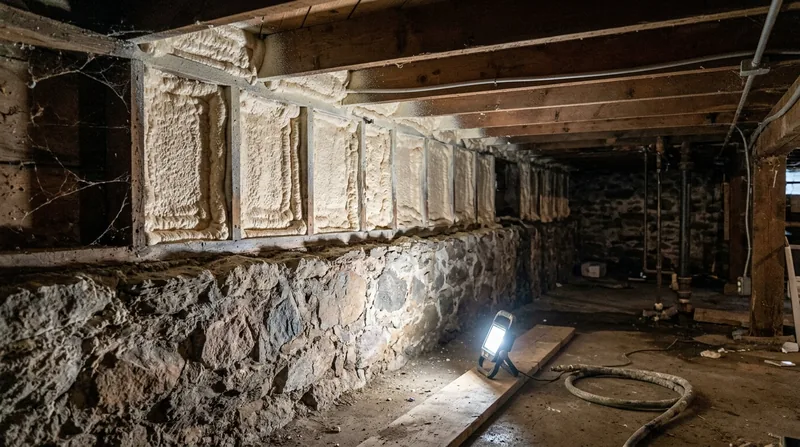




Closed cell spray foam insulation in Albany seals the rim joists, rim band, and uninsulated frame walls that leak cold air through most Capital Region homes. Albany's nineteenth-century rowhouses in Center Square and Pine Hills sit over stone and brick foundations with open rim joists that bleed heating energy all winter. Early-1900s frame houses and postwar colonials across Colonie, Guilderland, Bethlehem, and Delmar face the same problem: air leaks at the band joist, gaps in the rim, and moisture-driven condensation inside uninsulated walls. Closed cell foam stops that air movement, blocks vapor before it hits the dew point, and holds an R-value of 6 to 7 per inch, making it the right choice for basements, rim joists, and sealed attics where space is tight and performance must be high. Since 2013, we have sealed thousands of rim joists and foundation walls across Albany, Troy, Schenectady, and the surrounding towns. Let us show you how closed cell foam can cut your heating bill and protect your home from the moisture damage that plagues old masonry in zone 5A.
Why Closed Cell Spray Foam Matters in Albany Basements and Rim Joists
Albany's basements are the heating weak point. Most homes built before 1980 have open rim joists in stone or brick foundations, a gap between the top of the foundation wall and the house band joist where cold air pours in all winter. That same rim joist is where warm, moist indoor air leaks outward, hits the cold foundation, and condenses into water stains and rot. Closed cell foam seals both sides of that problem: it blocks the air leak and the vapor drive, holding an R-value high enough to make a measurable difference on the heating bill. In rowhouses along Lark Street and Madison Avenue, where shared party walls and shallow roof cavities already make heating inefficient, sealing the rim joist is often the single biggest payoff.
- Closed cell foam reaches R-6 to R-7 per inch, so 2 inches of foam in a rim joist cavity delivers R-12 to R-14 of insulation and air sealing in one pass.
- The foam cures into a rigid, load-bearing material that reinforces the rim band and does not settle, sag, or compress over time like fiberglass batts.
- Closed cell foam is vapor-closed, so it blocks warm, moist indoor air from pushing into the rim joist cavity and condensing on cold masonry.
- The foam adheres directly to stone, brick, and wood, creating an air barrier that fiberglass and cellulose cannot match.
- Rim joist foam is a small-ticket job, typically $800 to $2,000 per house, and the payback comes in the first two heating seasons.
Sealing the rim joist is the entry point for most homeowners, and it is the right place to start.
Key info: New York State Building Code requires that spray foam insulation in rim joists and basements be protected by a thermal barrier (usually 1/2-inch drywall) or a fifteen-minute ignition barrier applied directly to the foam. The local building department in Albany, Troy, Colonie, or Niskayuna will tell you which applies at your address. We help you navigate what the code requires, and we build it into the estimate.
For more on protecting your foundation, see our page on rim joist and band joist spray foam insulation.
How We Install Closed Cell Spray Foam in Albany Basements and Walls
Closed cell foam installation is a precise process that depends on equipment, ratio, temperature, and ventilation. We arrive with a truck-mounted rig, set up mechanical ventilation to manage fumes during the cure, and spray the foam in passes no thicker than 1 to 1.5 inches per application. The foam hardens in minutes, and we measure the cured thickness and R-value on site to confirm it meets your estimate. Most rim joist jobs take 4 to 6 hours from setup to cleanup, and the home is safe to re-enter after 24 to 48 hours of passive ventilation. For larger jobs, like sealing both the rim joist and uninsulated frame walls in a Colonie cape, we may need a second day.
- We inspect the rim joist and foundation for moisture, active leaks, or damage before we spray; if we find a wet substrate, we fix the leak first or we walk away.
- We set up negative-pressure mechanical ventilation during cure to pull fumes out of the house and protect your family.
- We spray the foam in controlled passes, measuring thickness after each pass to hit the R-value and thickness specified in your estimate.
- We apply the thermal barrier (drywall) or ignition barrier (if required by your local code) before the job is done.
- We provide a written receipt with the board feet installed, the R-value achieved, and the thickness at multiple points on the job.
Every job is documented so you have proof of what was done and what it performs.
Example: A 1,200-square-foot ranch in Latham with an open rim joist and uninsulated band wall typically runs 80 to 120 board feet of closed cell foam, installed in two passes over one day. The cost lands around $1,200 to $1,800 depending on access and local labor rates. The homeowner sees a 10 to 15 percent drop in the winter heating bill and no more cold drafts along the basement rim.
For details on how we handle larger attic and wall projects, see attic spray foam insulation and wall and injection foam insulation.
Closed Cell Spray Foam Installation Methods
| Method | Application | Best for |
|---|---|---|
| Rim Joist and Band Sealing | 2 to 3 inches of closed cell foam sprayed directly onto the rim joist cavity and band wall, with mechanical ventilation during cure. | Stone and brick foundations in Albany rowhouses and older homes; the entry-level job with the fastest payback. |
| Basement Wall Retrofit | 2 to 4 inches of closed cell foam sprayed onto the interior face of uninsulated basement walls and piers; creates a vapor barrier and thermal break. | Full basements in Colonie, Bethlehem, and Guilderland colonials and ranches; stops condensation on cold masonry during humid summers. |
| Sealed Attic and Roof Deck | 4 to 6 inches of closed cell foam sprayed onto the underside of the roof deck, creating an unvented attic space with no soffit ventilation required. | Low-slope roofs on rowhouses and flat-roof additions where ice dams form; also for conditioned attics and mechanical spaces. |
| Frame Wall Injection Foam | Closed cell foam injected into the cavities of existing frame walls through small holes, then sealed; no demolition required. | Pre-1980 frame houses with hollow walls; retrofits uninsulated walls from the inside without tearing out plaster or drywall. |
| Crawl Space and Stem Wall | 2 to 4 inches of closed cell foam sprayed onto the stem wall and header joist in unconditioned crawl spaces; controls moisture and blocks air infiltration. | Homes in Niskayuna, Rotterdam, and East Greenbush with shallow crawl spaces; keeps cold air and moisture from rising into the living space. |
Closed Cell Spray Foam Insulation Cost in Albany: What to Expect
Closed cell spray foam insulation in Albany typically starts at $1.20 to $1.50 per board foot, depending on the scope, access, and local labor. A standard rim joist and band wall job on a 1,200-square-foot house runs 80 to 120 board feet, landing in the $1,200 to $2,000 range. A larger project, such as sealing a basement rim joist plus uninsulated frame walls in a Colonie colonial, can run 200 to 300 board feet and cost $2,500 to $4,500. The final price depends on several concrete factors: the size of the area to be sealed, the thickness of foam required to hit your R-value target, the difficulty of access (finished basements or tight crawl spaces cost more), the condition of the substrate (wet or contaminated surfaces require remediation before foaming), and whether a thermal barrier or ignition barrier must be installed afterward.
We always provide a written estimate with the board feet, R-value, and thickness specified so you know exactly what you are paying for. We recommend getting 2 to 3 estimates from local contractors so you can compare the approach, the material, and the price. Beware of estimates with no R-value or thickness stated, prices far below market, or promises of immediate re-entry: those are the markers of a shop that cuts corners.
For a full breakdown of our pricing and what drives the cost, see our pricing page.
Closed Cell Spray Foam Insulation Near Me: What Albany Homeowners Should Know When Hiring a Contractor
Hiring the right spray foam contractor is the difference between a job that performs for twenty years and one that leaves you with fumes, gaps, or moisture damage. The spray foam trade has rig-and-run operations, national franchises, and local independents, and the local shop with a local address and accountability is your best bet. When you call for an estimate, ask the contractor for proof of insurance (we carry full coverage), references from jobs in your neighborhood, and an explanation of how they will handle ventilation and cure time. Ask whether they pull permits if your local building department requires them, and whether they will provide a written receipt with board feet, R-value, and thickness. Verify that the contractor understands the thermal barrier and ignition barrier rules that apply at your address: this is the single best signal of a shop that knows the code.
- Ask for references from homeowners in Albany, Troy, Schenectady, or Colonie who had rim joist or basement foam work done in the last two years.
- Request a written estimate with the board feet, R-value per inch, and thickness in inches stated clearly, plus the cost of any thermal or ignition barrier required by code.
- Confirm that the contractor will set up mechanical ventilation during the cure and provide a re-entry window of 24 to 48 hours before you live in the space.
- Check the contractor's insurance certificate and verify that it names your address as an insured location (not just a general liability policy with no project address).
- Ask whether the contractor has experience with your type of foundation (stone, brick, poured concrete) and whether they have handled moisture or prior water damage at your rim joist.
A good contractor will answer all of these questions clearly and will not rush you into a decision.
Ready to get started? Contact us for a free estimate at (838) 217-7813. We respond within 24 hours and can often schedule a site visit within a week.
Closed Cell Spray Foam Insulation in Albany: Pricing Guide
| Service | Price | Details |
|---|---|---|
| Rim Joist and Band Sealing | Starting at $1.20/board ft | Includes 2 to 3 inches of closed cell foam, mechanical ventilation during cure, and thermal barrier installation if required by local code |
| Basement Wall Retrofit | Starting at $1.35/board ft | Full-height uninsulated basement walls sealed with 2 to 4 inches of closed cell foam; cost rises with wall height and access difficulty |
| Sealed Attic or Roof Deck | Starting at $1.40/board ft | 4 to 6 inches of closed cell foam on roof deck with mechanical ventilation; larger attics and complex roof geometry require on-site estimate |
| Frame Wall Injection Retrofit | Starting at $1.25/board ft | Closed cell foam injected into existing wall cavities without demolition; cost depends on cavity depth, wall area, and number of injection holes required |
| Thermal or Ignition Barrier | From $1.50 to $2.50/sq ft | 1/2-inch drywall or specialized ignition barrier applied over foam to meet New York State Building Code requirements at your address |
| Free Estimate | No charge | Written estimate with board feet, R-value, and thickness specified; response within 24 hours at (838) 217-7813 |
Indicative pricing, the exact cost depends on square footage, finish, and site access. Free personalized estimate within 24h at (838) 217-7813.


