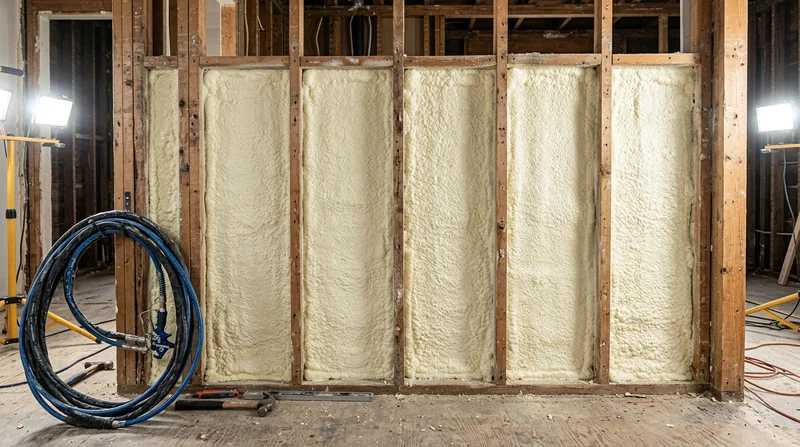




Open cell spray foam insulation in Albany fills the deep stud bays of postwar capes and colonials around Niskayuna and Latham, and it quiets the shared party walls of older Pine Hills rowhouses where sound and drafts travel freely between units. Albany's housing stock spans from nineteenth-century brick rowhouses with shallow roof cavities to early-1900s frame houses and postwar colonials spread through Colonie, Guilderland, Bethlehem and Delmar, most sitting over full basements with open rim joists that leak cold air all winter. In our cold, humid climate zone 5A, warm indoor air pushes into old masonry walls and attics where it condenses on cold surfaces, driving heating bills higher and creating moisture problems that conventional fiberglass cannot stop. Open cell foam fills those cavities completely, seals the air leaks around them, and costs less than closed cell because it requires no special vapor management. We've been installing spray foam insulation since 2013 across the Capital Region, and we know which product solves which problem in which house. This page covers when open cell is the right choice, how we install it, what it costs, and how to hire a contractor you can trust.
Why Open Cell Spray Foam Matters in Cold, Drafty Albany Homes
Open cell foam is less dense than closed cell but fills cavities completely and stops air movement through walls and ceilings. In the postwar colonials and capes that dominate Niskayuna, Latham and East Greenbush, deep 2x6 or 2x8 stud bays sit empty or contain settled fiberglass that no longer blocks air. Open cell foam expands to fill those cavities wall-to-wall, sealing every gap and air leak without the cost or vapor-barrier complexity of closed cell. It also absorbs sound, which makes it the natural choice for shared party walls in rowhouse blocks from Pine Hills to Center Square, where heating ducts and footsteps carry between units. In a zone 5A heating-dominated climate, the air sealing matters more than the R-value alone, and open cell delivers both.
- Fills deep stud bays in postwar frame houses completely, stopping air leaks that fiberglass misses.
- Absorbs sound in shared party walls, reducing noise transmission between rowhouse units.
- Costs less per board foot than closed cell, making it the practical choice for whole-wall retrofit in older stock.
- Requires no separate vapor barrier in heating-dominated climates when installed correctly at the right thickness.
- Expands to fill irregular cavities, voids and hard-to-reach spaces that conventional insulation cannot reach.
These advantages make open cell the standard choice for air sealing and sound control in the older residential neighborhoods of Albany and surrounding towns.
Key info: A Pine Hills rowhouse with party walls full of cold drafts and footstep noise typically needs open cell foam in the rim joist, rim band, and the shared wall cavity itself. A postwar ranch in Niskayuna with a 1970s addition and open stud bays in the attic space above the new room is the classic open cell retrofit job. Both jobs cost less with open cell than closed cell and deliver better sound control.
For regulatory guidance on attic ventilation, ignition barriers and thermal barriers in Albany, consult your local building department. New York State Energy Code requirements vary by address and building official, so verify what applies to your project before work begins. See the air sealing page for more on how foam and mechanical ventilation work together.
How We Install Open Cell Spray Foam Insulation in Albany Homes
Open cell foam is sprayed from a two-part system mixed at the gun and applied in layers to build thickness. We control the spray pressure, the ratio of resin to hardener, and the drum temperature to ensure even expansion and full cavity fill. The foam expands after application, so we spray it slightly proud of the cavity and trim it flush. During cure, we run mechanical ventilation to manage odor and VOC release, and we set a re-entry window of twenty-four to forty-eight hours before the space is safe to occupy. The process is the same whether we are filling a rim joist, a wall cavity, or an attic, but the cavity preparation and access route change with each job.
- We inspect the cavity, seal any large openings, and confirm the substrate is dry before spraying begins.
- We apply foam in thin, overlapping passes to build the target thickness and ensure complete fill without voids.
- We trim excess foam flush with the framing and install any required thermal or ignition barrier per code.
- We operate mechanical ventilation throughout cure and provide a clear re-entry timeline to the homeowner.
- We clean equipment and remove waste daily, leaving the site ready for the next trade or occupancy.
This methodical approach prevents the smell complaints and poor performance that plague rushed or poorly ventilated spray foam work.
Example: A rowhouse in Troy with a shared wall separating two units and an open rim joist above the basement. We seal the rim joist with open cell foam to stop cold air infiltration, then fill the shared wall cavity to R-13 or R-15 (3.5 to 4 inches) for sound and draft control. The job takes one day, and the owners can re-enter after 48 hours. Total cost is lower than if we used closed cell, and the sound reduction is immediate.
Read more about our approach to crawl space spray foam insulation, which follows the same controlled installation protocol.
| Approach | Description | Best for |
|---|---|---|
| Open Cell Wall Fill | Spray applied to 3.5 to 4 inches, R-13 to R-15, fills entire stud cavity from rim to top plate. | Postwar colonials and capes with open frame walls, shared party walls in rowhouses. |
| Attic Top-Up | 2 to 3 inches of open cell over existing fiberglass or mineral wool, seals air leaks and raises R-value. | Homes with settled or inadequate attic insulation, low-slope roofs prone to ice dams. |
| Rim and Band Joist Seal | Open cell fills the rim cavity, seals the header, and blocks cold air entry from the foundation. | Basements with open rim joists and stone or brick foundations, high heating bills. |
| Sound Control in Shared Walls | 3 to 4 inches of open cell absorbs airborne sound and reduces transmission between units. | Rowhouses, duplexes, and multi-unit buildings where party wall noise is a complaint. |
| Garage Ceiling Insulation | Open cell sprayed to R-15 or R-19 in garage ceilings, stops heat loss and condensation. | Attached garages in Colonie and Latham, heat loss through thin or missing insulation above. |
Open Cell Spray Foam Insulation Cost in Albany: What to Expect
Open cell spray foam costs less per board foot than closed cell because it uses less material to achieve the same R-value and requires no vapor barrier management. A typical residential job in Albany starts at $0.55 per board foot, though the final price depends on cavity size, access, complexity, and whether existing insulation must be removed first. A simple rim joist seal on a ranch in Rotterdam might run $800 to $1,200. A whole-wall retrofit in a rowhouse party wall could run $2,500 to $4,000. An attic top-up over existing insulation in a colonial in Niskayuna might run $1,500 to $2,500. The only way to know the cost for your house is to get a written estimate with R-value and thickness specs, and we provide that free within 24 hours.
Factors that move the price are the volume of foam needed (measured in board feet on site), the number of passes required to reach target thickness, whether we must remove old insulation first, and the complexity of cavity access. A job with difficult access, multiple cavities, or old insulation removal will cost more per board foot than a simple, open, accessible cavity. We always give you a number in writing before we start, and we charge only for the work done. If you are comparing estimates, make sure each one includes R-value, thickness, and board feet so you can compare apples to apples.
See our full pricing page for detailed ranges on all services, and call (838) 217-7813 for a free estimate on your specific job.
What to Look for When Hiring a Spray Foam Insulation Contractor Near Albany
Spray foam is a specialized trade, and the difference between a careful installer and a careless one shows up in odor, performance, and durability. A good contractor provides a written estimate with R-value and thickness, runs mechanical ventilation during cure, sets a clear re-entry window, and is reachable if questions arise after the job. A bad contractor gives you a price with no specs, promises immediate re-entry, and disappears when the smell lingers. Verify that any contractor you hire is fully insured and can provide a certificate of insurance. Check references from recent jobs in your area, and ask to see photos of the work. If the estimate is far below market with no explanation, walk away.
- Ask for a written estimate that includes R-value, thickness in inches, and total board feet of foam.
- Confirm that the contractor will run mechanical ventilation during cure and provide a re-entry window in writing.
- Request references from homeowners in Albany, Colonie, Niskayuna or nearby towns, and call at least two.
- Verify that the contractor is fully insured and obtain a copy of the certificate before work begins.
- Understand what permits apply at your address by asking your local building department, and confirm the contractor will help you navigate the process.
We are fully insured, provide written estimates with full specifications, and have been installing spray foam across the Capital Region since 2013. Call us at (838) 217-7813 for a free estimate and ask any questions about our process, insurance, or references.
Red flags: An estimate with no R-value or thickness, a promise of immediate re-entry, a price far below market with no detail, or insurance that cannot be verified. If a contractor cannot answer basic questions about foam type, cure time, or ventilation, or if they push you to decide on the phone without a site visit, that is a sign to call someone else. The best contractor is the one who asks questions about your house, the problem you are trying to solve, and whether spray foam is even the right answer.
Open Cell Spray Foam Insulation in Albany: Pricing Guide
| Service | Price | Details |
|---|---|---|
| Open Cell Wall or Cavity Fill | Starting at $0.55/board ft | 3 to 4 inches in stud bays, R-13 to R-15, complete cavity fill with no voids or air pockets |
| Rim Joist and Band Joist Seal | Starting at $0.55/board ft | Seals foundation perimeter, stops cold air infiltration, typically 50 to 150 board feet per basement |
| Attic Top-Up or Retrofit | Starting at $0.55/board ft | 2 to 3 inches over existing insulation, raises R-value and seals air leaks, volume depends on attic size |
| Insulation Removal and Replacement | On estimate | Old fiberglass, mineral wool, or failed foam must be removed before new foam, adds labor and disposal cost |
| Travel and Estimate | Included | No mileage fee or call-out charge in Albany and surrounding towns, free written estimate within 24 hours |
Indicative pricing, the exact cost depends on square footage, finish, and site access. Free personalized estimate within 24h at (838) 217-7813.


