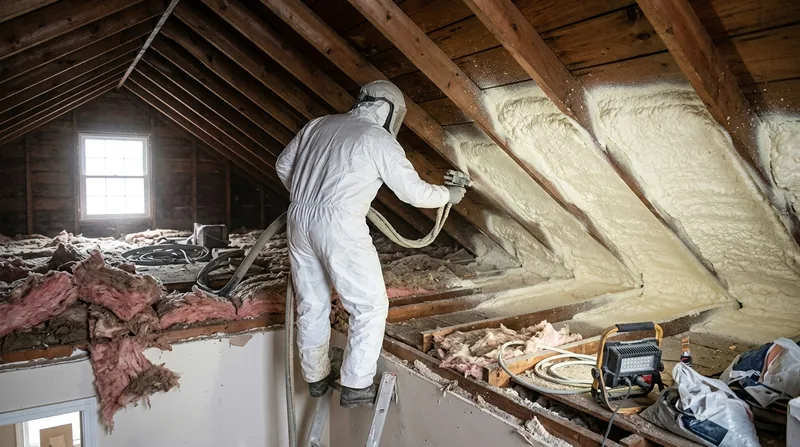




Homes across Albany, Colonie, Latham and Niskayuna built in the 1950s through 1980s were often insulated with fiberglass batts, blown cellulose, or nothing at all. After decades of settling, moisture damage, or ice dam repairs, that old insulation loses its R-value and leaves rim joists and attic cavities wide open to winter air. Insulation replacement and re-insulation removes the failed material, seals air leaks around the framing, and installs new spray foam sized for our cold climate zone 5A winters. The result is a tight thermal envelope that holds heat in winter and cuts the heating load that drives your bills from November through March.
Why Insulation Replacement Matters in Albany's Aging Housing Stock
Albany's residential core includes nineteenth-century brick rowhouses in Center Square and Pine Hills, early-1900s frame colonials scattered through Delmar and Bethlehem, and postwar capes and ranches across Colonie and Guilderland. Most of these homes sit over full basements with open rim joists that leak cold air all winter. The shallow roof cavities common in rowhouse blocks collect moisture from indoor humidity in winter, and that warm, moist air condenses when it hits the cold deck. Old insulation absorbs that moisture, compacts, and stops working. At the same time, ice dams form on low-slope roofs after heavy snow, forcing water under shingles and into the attic, which rots fiberglass and cellulose alike. A failed attic insulation job leaves your heating system running harder every month from October through April.
- We remove all old insulation material, including settled fiberglass, wet cellulose, and failed foam.
- We air seal the deck, rim joists, band joists, and top plate of exterior walls to block drafts.
- We install new closed cell or open cell spray foam calibrated for climate zone 5A heating loads.
- We specify R-value and thickness in writing so you know exactly what you are getting.
Replacing failed insulation is not optional in a cold climate. It is the single largest energy loss in an older Albany home, and it compounds every winter.
Key info: The New York State Energy Code (IECC 2020) requires attic insulation of R-38 to R-60 depending on your address and building class. Albany and Schenectady enforce the code through the local building department. Check your city's building office website or call to confirm what applies at your address before you estimate.
For more detail on attic work, see our attic spray foam insulation service page.
How Insulation Replacement Works: Our Process in Albany Homes
We start with a site visit to assess the existing insulation, check for moisture damage or pest contamination, and measure the cavity depth and width. If the old material is wet, moldy, or infested, we remove it safely and dispose of it according to New York waste rules. We then air seal all gaps, cracks, and penetrations in the rim joist band, the rim board itself, the band joist cavity, and around plumbing and electrical chases in the attic. Once the air barrier is complete, we spray new foam to the specified thickness and R-value, allowing it to cure under mechanical ventilation before re-entry.
- We inspect the existing insulation and the framing for moisture, settling, or damage.
- We remove old material and haul it to a licensed disposal facility.
- We identify and seal all air leaks in the cavity, rim board, and exterior wall top plate.
- We spray new foam in even passes at the correct ratio and drum temperature.
- We ventilate the space mechanically during cure and specify a re-entry window of 24 to 48 hours.
- We provide a written estimate with R-value, thickness, and square footage so you can verify the work.
The entire process ensures that new insulation sits on a clean, dry, sealed substrate and performs at its rated R-value for decades.
Local example: A 1970s ranch in Niskayuna with a 1,200 square-foot attic under a low-slope roof typically takes 3 to 5 days from removal through cure. The homeowner stays out of the attic for 48 hours while the foam off-gasses. After that, the space is fully occupied and the heating season begins with a sealed, R-60 attic.
See our insulation removal service page for details on safe disposal of old material.
Insulation Replacement Methods: Open Cell vs. Closed Cell
| Approach | Description | Best for |
|---|---|---|
| Open Cell Spray Foam | Lightweight, semi-rigid foam that expands after spraying. Low density, good sound dampening, lower cost per board foot. | Attics in homes where budget is a priority and the space is heated and vented to the outdoors. R-value per inch is lower, so thickness must be greater. |
| Closed Cell Spray Foam | Dense, rigid foam with closed cells that trap air and moisture. High R-value per inch, vapor barrier properties, excellent moisture control. | Attics under low-slope roofs where ice dams are common, rim joists over stone foundations, and any cavity where moisture vapor drive is a risk in our cold, humid climate. |
| Removal and Top-Up | Remove settled or wet insulation, air seal the framing, and add new foam only to reach the target R-value. Minimizes material cost and disruption. | Attics where the existing cavity is sound and the old foam or fiberglass is still partially effective but has lost thickness or settled unevenly. |
| Full Cavity Fill | Remove all old material and fill the entire cavity with new foam from rim to deck or header to header. Ensures uniform R-value and complete air sealing. | Homes with deep cavities, prior water damage, or where the existing insulation is contaminated or failed completely. |
The right method depends on your attic depth, the age and condition of the old insulation, and your heating load in zone 5A. We recommend closed cell for rim joists and low-slope attics in our climate because vapor drive from inside the house pushes warm, moist air into the cold rim board all winter, and closed cell blocks that moisture. For a standard attic with good framing and moderate moisture risk, open cell is often the better value and still delivers the air sealing you need.
Insulation Replacement and Re-Insulation Cost in Albany: What to Expect
Insulation replacement in Albany typically starts at $2,800 for a small attic (500 to 800 square feet) and scales up based on cavity size, depth, the type of foam you choose, and how much old material must be removed. A full-size attic in a Colonie colonial or Latham ranch (1,200 to 1,600 square feet) usually runs $4,500 to $7,500 depending on whether you choose open cell or closed cell, the R-value target, and the condition of the existing framing. Rim joist and band joist work in a home with a full basement runs $1,500 to $3,500 depending on the linear footage and whether the foundation is stone, brick, or poured concrete.
Several factors shift the final cost. If the old insulation is wet or contaminated, removal takes longer and disposal costs more. If the attic or rim joist cavity is blocked by HVAC ducts, plumbing, or electrical, spray coverage becomes more complex. If you choose closed cell instead of open cell, the per-board-foot cost is higher but the R-value per inch is greater, so you may need less thickness. Access also matters: a narrow attic hatch or a basement rim joist in a tight corner takes more time to spray carefully than a wide-open space.
The best way to know your actual cost is to request a free, no-obligation estimate. We measure your cavity in person, specify the R-value and thickness in writing, and give you a firm number before we start. Call us at (838) 217-7813 or visit our pricing page for ballpark ranges on common job sizes.
Insulation Replacement and Re-Insulation Near Me: What Albany Homeowners Should Know Before Hiring
When you are ready to replace failed insulation, verify that any contractor you call is fully insured and can provide a certificate of insurance on request. Ask for references from recent jobs in your neighborhood (Albany, Colonie, Latham, or Troy) and follow up with at least one. Request a written estimate that specifies the R-value, thickness in inches, and total square footage so you can compare apples to apples. Do not accept an estimate with no R-value or thickness, no insurance verification, or a price far below the market: those are markers of a rig-and-run crew that sprays fast, leaves no documentation, and disappears when the smell does not go away or the foam cures unevenly.
Ask whether the contractor pulls permits if your city requires one. Permitting rules vary across Greater Albany: some municipalities require a permit for attic insulation work, others do not. The contractor should know the rule for your address and help you navigate it, not promise to handle it without checking. If your home is in a historic district (such as Center Square in Albany or parts of Delmar) or under an HOA, ask whether the exterior work or any roof access is subject to architectural approval. Most HOAs do not regulate insulation, but they do govern exterior work on metal buildings and pole barns in master-planned areas.
- Confirm that the contractor is fully insured and will provide a copy of the policy before work begins.
- Request at least two other estimates so you can compare R-value, thickness, and price side by side.
- Ask whether the old insulation will be removed safely and disposed of according to state waste rules.
- Verify that mechanical ventilation will be used during cure and that the contractor specifies a re-entry window.
- Get a written estimate with R-value, thickness, and square footage, and ask what happens if the cavity is deeper or shallower than expected.
The strongest sign of a professional installer is one who asks you questions about moisture, prior damage, and how the space is used before offering a price. Call us at (838) 217-7813 or contact us online for a free estimate with no obligation.
Insulation Replacement & Re-Insulation in Albany: Pricing Guide
| Service | Price | Details |
|---|---|---|
| Small Attic Insulation Replacement | Starting at $2,800 | 500 to 800 square feet, open cell foam, removal and disposal of old material included |
| Standard Attic Replacement (1,200 to 1,600 sq ft) | Starting at $4,500 | Typical ranch or colonial attic, open cell or closed cell, complete removal and air sealing of rim and deck |
| Rim Joist and Band Joist Replacement | Starting at $1,500 | Basement perimeter insulation, 100 to 200 linear feet, closed cell foam for moisture control on stone or brick |
| Large or Complex Attic Replacement | On estimate | Deep cavities, wet or contaminated insulation, blocked access, or mixed open and closed cell work requires on-site measurement |
| Travel and Estimate | Free | No charge for travel within Albany and surrounding towns, free written estimate with R-value and thickness specs |
Indicative pricing, the exact cost depends on square footage, finish, and site access. Free personalized estimate within 24h at (838) 217-7813.


