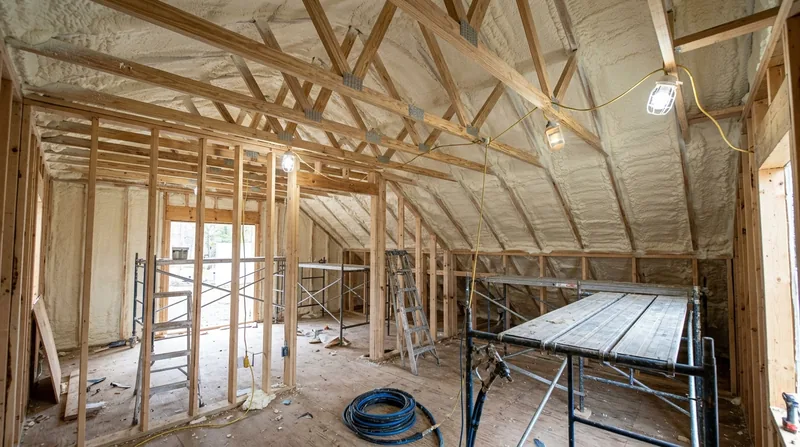




Commercial and new construction spray foam insulation in Albany and the Capital Region serves a straightforward purpose: seal the cavities and air leaks that drive heating and cooling waste in small commercial buildings, new construction shells, and retrofit projects across Rensselaer, Albany, Saratoga and Columbia counties. From the brick rowhouses and frame structures of Center Square to the metal buildings and agricultural barndominiums scattered through rural towns like Amsterdam, Ballston Spa and Hudson, the same failure mode repeats. Old cavities hold no insulation, new construction cavities are left open until the weather forces closure, and both leak air all winter and summer. We spray foam attics, walls, rim joists and entire shells in new builds and retrofits, installing a continuous air barrier that stops the drafts and moisture drive that turn heating bills into a permanent expense.
Why Commercial and New Construction Spray Foam Matters in Albany's Building Stock
The Capital Region's commercial and industrial footprint includes small office buildings, warehouse shells, automotive shops, storage facilities and agricultural structures that face the same thermal challenges as residential stock. A one-story commercial building with an uninsulated attic or a metal-frame warehouse with an open roof cavity loses heat through the envelope in winter and gains it in summer at rates that fiberglass batts or blown-in insulation simply cannot arrest. New construction projects often sit with open cavities for weeks or months during framing and rough-in phases, exposing framing lumber and subfloors to moisture and temperature swings that invite cupping, rot and mold. Spray foam insulation solves both problems by creating a monolithic air barrier and thermal layer in a single pass, with no gaps, no settling and no thermal bridging at studs or joists.
- We spray closed-cell or open-cell foam into attic cavities, roof decks and wall assemblies during new construction framing before drywall and cladding close the space.
- We retrofit existing commercial buildings by injecting foam into walls, sealing rim joists and band joists, and encapsulating attic cavities without tearing into finished surfaces.
- We seal metal buildings and barndominiums where condensation control is non-negotiable and fiberglass offers no vapor barrier or adhesion to steel framing.
- We coordinate with mechanical contractors, electricians and plumbers to work around existing utilities and ensure that mechanical ventilation runs during foam cure.
These measures cut heating and cooling load, stop ice dam formation on low-slope roofs, and prevent the moisture accumulation that ruins insulation and framing in climate zone 5A.
Key info: New York State building code requires that spray foam installations include a thermal barrier (fifteen-minute fire rating) or an ignition barrier, depending on the cavity and its use. We follow the code in force at your address and defer all interpretations to the local building department. Permits and contractor registration vary by city across Greater Albany, so we help you navigate what applies at your specific location.
For detailed guidance on what permits and inspections apply to your commercial project, contact the building department in your municipality or visit the New York State Department of Environmental Conservation energy code page.
How We Install Commercial and New Construction Spray Foam in Albany
Commercial and new construction projects demand coordination, precision and a clear understanding of the building's use and occupancy. We begin with a site visit to measure cavities, identify framing patterns, locate utilities, and confirm the foam type and thickness required by the architect, engineer or energy code. We then schedule the spray during the framing or retrofit phase when cavities are accessible, coordinate mechanical ventilation to run during cure, and manage the re-entry window so trades can return safely. On new construction, we often work alongside electricians and HVAC crews to spray around conduit, ductwork and penetrations. On retrofits, we may need to remove existing insulation or debris before foam application begins.
- We visit the site, measure cavities, review plans and confirm the foam type, thickness and R-value required by code or design.
- We schedule spray during framing or retrofit phases when cavities are fully accessible and coordinate with other trades.
- We set up mechanical ventilation to run during foam application and curing, typically twenty-four to forty-eight hours depending on foam type and ambient conditions.
- We apply foam in controlled passes, maintaining the manufacturer's specified ratio, drum temperature and application thickness to ensure consistent density and R-value.
- We install thermal or ignition barriers as required by code, and we coordinate final inspections with the building department.
This process ensures that every cavity receives the full R-value specified and that the installation meets both code and the performance guarantees of the foam system.
Local example: A new metal agricultural building in Ballston Spa requires a sealed roof deck to prevent condensation on the steel frame during cold months. We spray closed-cell foam to the underside of the metal roof, creating a continuous air barrier and vapor barrier that stops moisture from reaching the steel and rusting it. The foam also adds R-value and sound dampening. A retrofit warehouse in Troy with an open attic cavity over a finished office space gets open-cell foam, which is faster to apply, lower cost, and offers sound absorption without the moisture risk of a sealed attic.
Commercial and New Construction Spray Foam Methods
| Approach | Description | Best for |
|---|---|---|
| Closed-Cell Spray Foam | Dense, rigid foam with high R-value per inch (R-6 to R-7) and integral vapor barrier. Cures hard and bonds to framing. Requires precise equipment and drum temperature control. | Metal buildings, sealed roof decks, condensation-prone cavities, high-moisture environments, retrofit walls where space is tight. |
| Open-Cell Spray Foam | Lower-density foam with moderate R-value per inch (R-3.5 to R-3.8) and sound-dampening properties. Cures soft and allows vapor to diffuse. Faster application, lower cost per board foot. | Attics, interior walls where sound control is valued, retrofit spaces with adequate depth, new construction with standard framing. |
| Injection Foam (Wall Retrofit) | Closed-cell or open-cell foam injected into closed wall cavities through small holes drilled from outside or inside. Fills cavities without demolition. Requires careful hole spacing and pressure control. | Retrofit commercial buildings with masonry or frame walls, historic structures, buildings where interior or exterior finishes cannot be disturbed. |
| Attic and Roof Deck Encapsulation | Spray foam applied to underside of roof sheathing or attic floor to create sealed, conditioned attic space. Moves thermal boundary to roof plane. Requires attention to ventilation codes and thermal barriers. | New construction and retrofit commercial buildings with low-slope roofs, bonus spaces, mechanical systems in attics, buildings with ice dam or moisture problems. |
Commercial and New Construction Spray Foam Cost in Albany: What to Expect
The cost of spray foam insulation for commercial and new construction projects depends on several concrete factors: the size and complexity of the cavity, the foam type (closed-cell is denser and more expensive per board foot than open-cell), the accessibility of the space, the presence of existing insulation to remove, and the distance from our shop to your site. We provide a free commercial estimate that includes a site visit, measurement of all cavities, a specification of foam type and thickness, and an R-value calculation. This estimate is binding on labor and materials for thirty days and includes all coordination with other trades and mechanical ventilation during cure.
For a typical commercial attic retrofit in Albany or Colonie, closed-cell spray foam to R-21 runs in the mid-range of the market, while open-cell foam to the same R-value costs less per square foot but requires more thickness. A new construction metal building shell with closed-cell foam under the roof deck and around rim joists represents a larger project and a higher total cost, but the per-board-foot rate is lower because of the volume and efficiency of application. Metal buildings and barndominiums in Niskayuna, Rotterdam and surrounding areas often benefit from closed-cell foam because of the condensation risk on steel, which adds to cost but is necessary for durability.
We recommend getting two or three estimates from local spray foam contractors to compare not just price but also the R-value and thickness specified, the warranty terms, and the installer's track record with commercial projects in your area. A low estimate with vague specifications or no written R-value and thickness is a red flag. For detailed pricing and to schedule your free commercial estimate, visit our pricing page or call (838) 217-7813.
What to Look for When Hiring a Spray Foam Contractor Near Albany
The spray foam insulation market includes local independent shops, regional franchises and out-of-state crews that arrive in a trailer, spray a job in an afternoon and disappear. The differences matter. A local contractor with a local address and local insurance can be held accountable if the smell lingers, if the foam fails to cure properly, or if the installation does not meet code. Before you hire any contractor, verify that they carry full insurance coverage and can provide a certificate of insurance naming your project. Ask for references from recent commercial projects in Albany, Schenectady or nearby towns, and call those references to ask about curing time, odor, re-entry timing and any post-installation issues.
- Verify that the contractor is fully insured and can provide a certificate of insurance before work begins.
- Request a written estimate that specifies the foam type, R-value, thickness and the total board feet to be installed.
- Ask for at least three references from commercial projects completed in the past two years in your area.
- Confirm that the contractor will run mechanical ventilation during foam cure and provide a clear re-entry window, typically twenty-four to forty-eight hours.
- Understand what permits apply to your project by contacting your local building department, and confirm that the contractor will coordinate inspections.
- Ask whether the contractor has experience with your specific building type, metal buildings, sealed attics or injection foam retrofit, and whether they carry a workmanship warranty on the installation.
A contractor who can answer these questions clearly and provide documentation is one you can trust to deliver a sound installation. For a free commercial estimate and references from recent projects in Albany and surrounding areas, contact us or call (838) 217-7813.
Commercial & New Construction Spray Foam in Albany: Pricing Guide
| Service | Price | Details |
|---|---|---|
| Free commercial estimate | Free | Site visit, cavity measurement, foam type and thickness specification, R-value calculation, binding for thirty days |
| Closed-cell spray foam, typical attic retrofit | Starting at $1.50 per board foot | Cost varies by cavity depth, existing insulation removal, accessibility and distance from our shop in Albany |
| Open-cell spray foam, typical attic or interior wall | Starting at $0.90 per board foot | Lower cost than closed-cell, requires more thickness for same R-value, faster application, sound dampening included |
| Metal building or sealed roof deck, closed-cell foam | Starting at $1.50 per board foot | Condensation control on steel, new construction or retrofit, larger volume projects qualify for volume pricing |
| Travel and coordination | Included | No separate mileage fee within Albany and surrounding service areas, coordination with trades included |
| Estimate response time | Within 24 hours | Call (838) 217-7813 or submit a project description online for scheduling and free commercial estimate |
Indicative pricing, the exact cost depends on square footage, finish, and site access. Free personalized estimate within 24h at (838) 217-7813.


