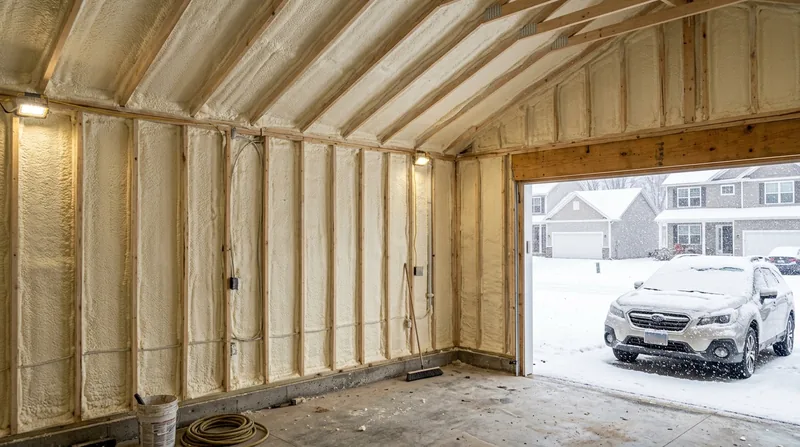




Garage spray foam insulation in Albany transforms unheated workshop and storage space into usable areas through the cold climate zone 5A winter. Detached garages across Colonie, Guilderland, and the surrounding Capital Region sit exposed to snow, ice, and drafts that make them nearly unusable from November through March. Spray foam on the walls and ceiling seals air leaks, stops radiant heat loss, and keeps stored equipment, vehicles, and workshop gear protected without the noise and cost of running a space heater all season. Unlike fiberglass batts or loose-fill blown-in, foam creates a continuous air barrier that eliminates the cold spots where condensation forms on metal shelving and tool racks. We have been installing garage foam since 2013 across Albany, Troy, Schenectady, and the surrounding towns, and we understand the specific failure modes that plague uninsulated garages in this region.
Why Garage Insulation Matters in Albany and the Capital Region
Garages in Albany and neighboring towns face a harsh combination of exposure and neglect. Most detached garages built before 2000 have no insulation at all, and many sit on concrete slabs or shallow foundations that conduct cold directly into the floor. The rim joist and band board at the top of the garage walls are wide open to the outside air, and roof decks lack any thermal barrier. During the snowy months, indoor air that warms during the day rises and leaks out through the ceiling and upper walls, wasting energy and making the space uncomfortable. Spray foam stops that air movement, holds heat where you need it, and keeps the space usable for storage, woodworking, or vehicle maintenance without the smell and fire risk of a portable heater.
- Spray foam seals the rim joist and band board where cold air enters around the perimeter of the garage.
- Foam on the ceiling and upper walls stops warm air from escaping into the attic or roof cavity above.
- A continuous air barrier prevents condensation on metal shelving, tool chests, and vehicle surfaces during temperature swings.
- Insulated garages reduce the temptation to run inefficient space heaters, cutting utility costs and fire risk.
- Foam adds structural stiffness to the garage frame and can help dampen sound from wind and passing traffic.
These benefits compound when the garage is attached to the house or located near living spaces, because air leaks from an uninsulated garage pull cold air into adjacent rooms and increase heating demand across the whole building.
Key info: Albany sits in IECC climate zone 5A, with winter heating bills driven by air leaks in rim joists, uninsulated walls, and open attics. A detached garage with no insulation and an open rim joist can lose as much heat as a small bedroom left with the window open all winter. Spray foam on the garage ceiling and walls typically costs from $1,200 to $2,800, depending on the size and complexity of the space.
For more information on how foam insulation works in cold climates, see our guide to closed cell spray foam insulation, which is the standard choice for garage walls and ceilings because it stops air movement and resists moisture.
How We Insulate Garages in Albany: The Step-by-Step Process
Garage spray foam insulation starts with a site visit to measure the walls, ceiling, and any rim joist or band board exposure. We assess the existing structure, identify air leaks, and determine whether the garage has any moisture problems or roof leaks that need to be addressed before foam is applied. Once we understand the scope, we prepare the space by protecting floors and any equipment, then seal and tape any gaps or penetrations that would allow foam to flow out of the cavity. We apply foam in multiple thin passes to ensure consistent thickness and proper density, with mechanical ventilation running throughout the cure period. After the foam cures, we trim excess material flush with the framing and leave the surface ready for drywall, paneling, or other interior finish if you choose.
- We conduct a free on-site estimate to measure the garage, identify air leaks, and confirm the scope of work.
- We protect the floor and any stored items, and we tape or seal openings to control where foam flows.
- We apply closed cell or open cell foam in controlled passes, maintaining proper thickness and drum temperature.
- We run mechanical ventilation during the cure period to manage off-gassing and ensure safe re-entry.
- We trim excess foam flush with the framing and leave the surface clean and ready for finish materials.
- We provide written documentation of the foam type, R-value, and thickness applied to each section.
The entire process typically takes one to three days, depending on the size of the garage and whether additional work like air sealing around doors, windows, or penetrations is included.
Example: A two-car detached garage in Colonie measuring 20 by 24 feet with an 8-foot ceiling and an open rim joist typically receives closed cell foam on the ceiling (R-21 at 3.5 inches), on the upper 4 feet of the walls (R-14 at 2.5 inches), and on the rim joist band board (R-21 at 3.5 inches). Total coverage is roughly 800 to 1,000 board feet, with work completed in a single day and re-entry permitted after 24 to 48 hours.
Garage Spray Foam Methods: Closed Cell vs. Open Cell
| Approach | Description | Best for |
|---|---|---|
| Closed Cell Spray Foam | High-density foam (3.5 to 5 lbs/cu ft) with closed cellular structure. Provides R-6.5 to R-7 per inch, resists water absorption, and acts as an air and vapor barrier. Requires proper installation and ventilation during cure. | Garage ceilings, rim joists, and exterior walls where moisture resistance and maximum R-value per inch are priorities. Standard choice for unheated garages in cold climates. |
| Open Cell Spray Foam | Low-density foam (0.5 to 1.5 lbs/cu ft) with open cellular structure. Provides R-3.5 to R-3.7 per inch, allows vapor transmission, and costs less per board foot. Requires thicker application to reach target R-values. | Garage interiors where sound dampening and lower cost matter more than maximum thermal resistance. Less common for garages in zone 5A because thicker application is needed. |
| Closed Cell on Rim Joist Only | Targeted closed cell foam applied only to the band board and rim joist where the most significant air leaks occur, leaving the rest of the garage uninsulated or topped with blown-in fiberglass. | Budget-conscious projects or garages where the ceiling and walls are already partially insulated. Reduces cost while still blocking the biggest air leak path. |
| Full Enclosure with Drywall | Closed cell foam applied to walls, ceiling, and rim joist, then covered with drywall, vapor barrier, and finish materials. Creates a fully conditioned interior space suitable for living or working. | Garage conversions to living space, heated workshops, or premium storage where finished appearance and maximum comfort are required. Requires compliance with building code and permits. |
Closed cell foam is the standard for Albany-area garages because it stops air movement, resists moisture from snow melt and humidity, and reaches target R-values with thinner application. Open cell is chosen mainly for cost savings or sound control, but it requires thicker coverage and does not resist moisture as effectively in our cold, humid climate.
Garage Spray Foam Insulation Cost in Albany: What to Expect
Garage spray foam insulation in Albany typically starts at $1,200 to $1,500 for a single-car garage with walls and ceiling, and rises to $2,000 to $3,200 for a two-car garage with full coverage. The primary cost drivers are the size of the space, the R-value and thickness you choose, access for equipment, and whether existing insulation or debris needs to be removed first. A rim joist and band board only, without ceiling or wall coverage, may run $600 to $1,000 for a standard garage. Travel and site preparation are included in our estimates for Albany and the surrounding towns, with no separate mileage charge.
The cost per board foot of closed cell foam ranges from $1.20 to $1.80 depending on market conditions, material cost, and labor complexity. A 20-by-24-foot garage with 8-foot walls and closed cell on the ceiling and upper walls typically requires 800 to 1,200 board feet, placing the material and labor cost in the $1,200 to $2,200 range. If you add drywall, vapor barrier, or electrical work after the foam is installed, those costs are separate and quoted independently.
The best way to understand the cost for your specific garage is to request a free written estimate that includes the R-value, thickness, and total board feet for each section. We respond within 24 hours and provide a firm price with no surprise add-ons. Visit our pricing page for a detailed breakdown of typical jobs, or call us at (838) 217-7813 to discuss your garage and get a quick ballpark figure.
Garage Spray Foam Insulation Near Me: What Albany Homeowners Should Know When Hiring
Hiring a spray foam contractor for your garage is a decision that affects comfort, safety, and long-term value. The spray foam industry includes both highly professional local shops and out-of-state rig-and-run crews that disappear after the job is done. The difference shows up in the estimate, the installation process, and what happens if questions arise weeks later. A strong contractor provides a written estimate with R-value and thickness clearly stated, maintains full insurance coverage, follows the manufacturer's guidelines for drum temperature and mix ratio, runs mechanical ventilation during the cure, and commits to a stated re-entry window of 24 to 48 hours.
- Request a written estimate that includes the foam type, R-value per inch, thickness in each section, and total board feet.
- Verify that the contractor is fully insured and ask to see the insurance certificate naming your address as a project site.
- Ask whether the contractor will run mechanical ventilation during the cure and what the re-entry window is before you can use the garage.
- Confirm that any permits required by your city or town are obtained before work begins, and defer to the local building official on code compliance.
- Check references from recent garage projects in your area, and ask about the contractor's response time if you have questions after the job is complete.
- Understand the difference between a workmanship warranty (typically one to three years) and a manufacturer system warranty, and ask which applies to your project.
A professional estimate is the first filter: if a contractor quotes a price with no R-value, no thickness, and no board foot total, or if the price is far below market with no inspection of the space, that is a sign of poor preparation and higher risk of callbacks and quality issues. Conversely, a contractor who takes time to measure, explain the process, and provide a detailed written estimate is positioning for a professional relationship and long-term accountability.
For questions about permits, building codes, or contractor requirements in your specific city or town, contact the local building department or visit the contact page to discuss your project with our team. We help homeowners understand what applies at their address and navigate the permitting process when required. We serve Albany, Troy, Schenectady, Colonie, Niskayuna, Rotterdam, Cohoes, Watervliet, Latham, East Greenbush, Loudonville, Menands, Rensselaer, Scotia, Saratoga Springs, Amsterdam, Ballston Spa, Hudson, Glens Falls, and Voorheesville.
Garage Spray Foam Insulation in Albany: Pricing Guide
| Service | Price | Details |
|---|---|---|
| Single-car garage, walls and ceiling | Starting at $1,200 | Closed cell foam on ceiling and upper walls, rim joist sealed, typical 600 to 900 board feet coverage |
| Two-car garage, full coverage | Starting at $2,000 | Closed cell foam on ceiling, walls, and rim joist, 800 to 1,200 board feet, one-day installation |
| Rim joist and band board only | Starting at $600 | Targeted closed cell foam on perimeter air leak, no ceiling or wall coverage, 200 to 400 board feet |
| Full enclosure with drywall and finish | On estimate | Closed cell foam plus drywall, vapor barrier, and interior finish materials require site assessment and code review |
| Travel and site prep | Included | No separate mileage or call-out fee for Albany and surrounding towns within service area |
| Free written estimate | No obligation | Response within 24 hours, includes R-value, thickness, and board feet for each section, call (838) 217-7813 |
Indicative pricing, the exact cost depends on square footage, finish, and site access. Free personalized estimate within 24h at (838) 217-7813.


